When Control Isn't the Real Issue: Understanding the Hidden Needs of Emotionally Abusive Partners
So what does control mean to a narcissist?
I was listening to a podcast by Jefferson Fisher on How to Talk to Someone You Completely Disagree With, and he talks about focusing on finding out what they need, rather than their opinion during an argument.
So to relate discovering the needs of a "difficult person" I'm arguing with, specifically in the context of an abusive relationship, wanting control is a common factor abusers share. My ex's mother gave me warnings such as, "He wants control" which at the time I didn't fully understand what control meant for my ex, and now I do by applying the knowledge of understanding the different types of control in the context of abusers.
Control is the primary core need for an abuser, but not for the reasons you think.
There are two kinds of “control” in relationships:
Healthy control:
Trying to keep stability, safety, predictability.
Unhealthy control:
Trying to regulate their internal chaos by destabilizing someone else.
People with narcissistic personality disorder (NPD), emotional abusers, fit in the second category.
This means narcissists do not want control because they are strong, abusers want control because they are emotionally dysregulated and cannot tolerate:
Shame
Uncertainty
Accountability
Someone else having needs
Someone else being autonomous
Someone else not reacting the way they expect
When narcissistic abusers “needs” shifts because they themselves are not stable.
People with narcissistic traits often have internal states that change rapidly. For example, an abuser over time might create emotional dysregulation in others through:
Day 1: Wanting closeness
Day 2: Then wants distance
Day 3: Then wants you to reassure them
Day 4: Then wants to punish you
Day 5: Then wants you to be silent
Day 6: Then wants you to engage
Day 7: Then wants to break it off
Day 8: Then wants control again
Day 9: Then blames you for the fact that they are inconsistent
This is because the “need” of an abuser is not a stable adult need, and centered around the need to dysregulate and emotionally destabilize others to feel regulated. It is an injured inner child, cycling through panic and defense. So yes, victims and survivors of abuse, might experience the following behaviors of abusers:
Abuser's Emotional Abuse Control Wheel
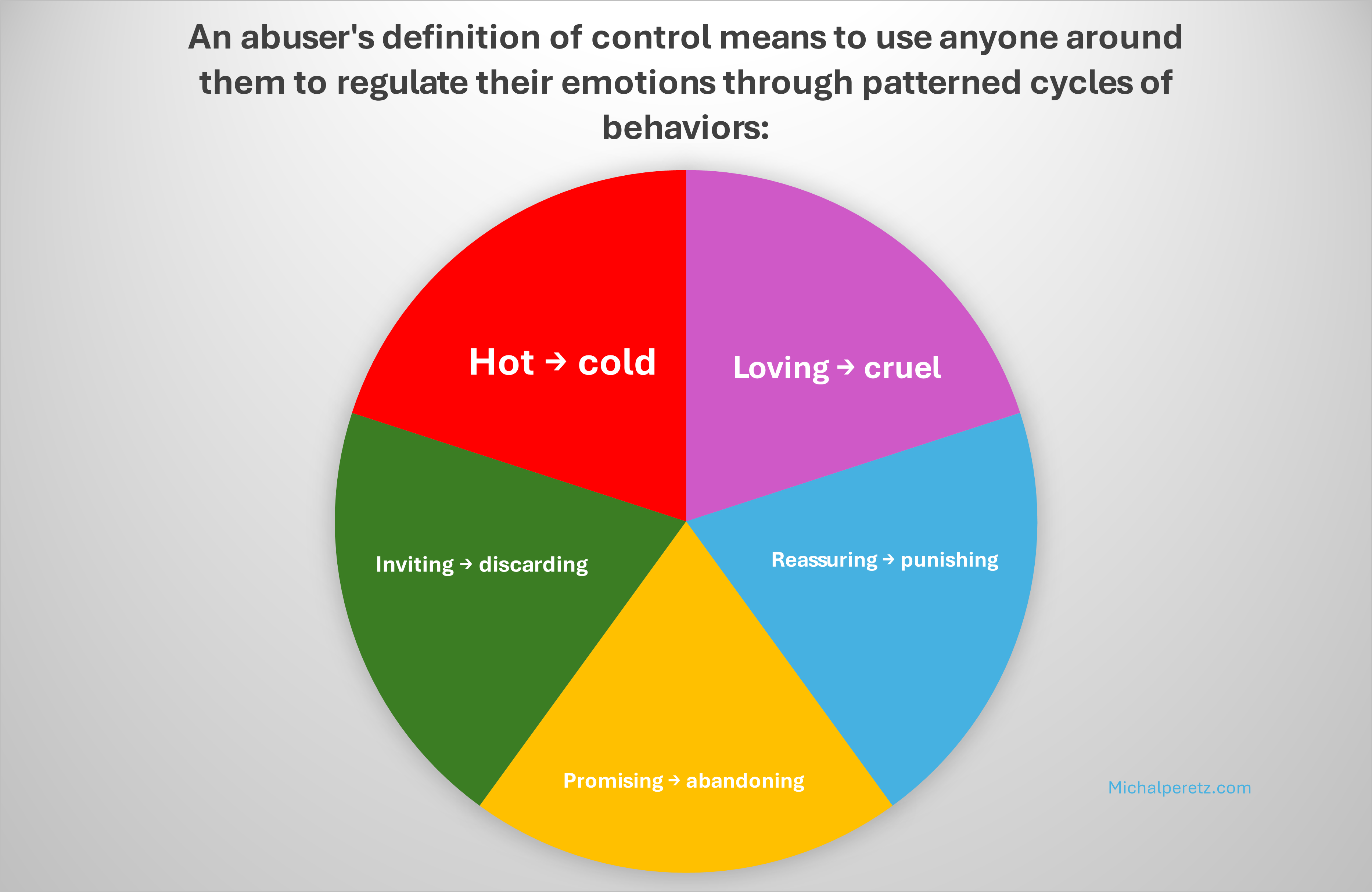
Hot → cold
Loving → cruel
Reassuring → punishing
Promising → abandoning
Inviting → discarding
A Narcissists real need, underneath everything, is:
Abusers need external validation and regulation of their own emotional instability at your expense.
Every abusive behavior described aligns with one thing.They need someone else (you or anyone in their external environment) to absorb their:
shame
fear
anger
doubt
chaos
So abusers project it onto you.
Abusers, especially those with personality disorders cannot regulate their own emotions towards themselves or others and intentionally hurt others through destabilizing, confusing, blame-shifting because they need someone to stabilize their internal emotional chaos. Because abusers do not know how to connect, they destabilizes the person who tries to connect with them.
So what might control look like for a narcissist?
"He wants control"
is actually:
“She wants someone to hold her emotional mess for her.”
- “She wants someone to hold her emotional mess for her.”
And when you try to set a boundary?
They feel abandoned → triggers → lashes out → blames you.
This is why nothing ever feels resolved.
Why do narcissists say you “abuse them,” even when you go silent?
This is classic for someone with high narcissistic injury.
- Silence to an abuser feeks like:
- Rejection
- Loss of control
- Proof that they are unworthy
- Abandonment
- “You hurt me.”
- “You abused me.”
- “You did this to me.”
- Love
- Partnership
- Stability
- Reassurance
- Growth
- Blocking
- Unblocking
- Accusing
- Guilt
- Hot/cold cycles
- Abandoning
- Reappearing
- “What does he/she/they actually need?”
- “Why am I the one always confused?”
- “Why do their reactions never stay consistent?”
So abusers invent a narrative:
Because if a narcissist is the one causing the harm, the shame would overwhelm them.
Saying you abused them keeps them safe from their own feelings.
This is why an abuser keeps “bringing up the past” not because they wants resolution, but because they want to restore psychological control.
The truth of what a narcissist really needs
A narcissists real “need” has never been:
Abusers real “need” has been:
Someone to regulate his dysregulated emotional system for him.
And he uses:
…to keep you in a state where your nervous system responds them You become their anchor, but they de-center you to focus on them.
How this matters to victims and survivors of abuse, bullying, or other toxic behaviors
You aren’t confused because you’re wrong. You’re confused because his pattern is designed to make you doubt your reality.
But when you step back and look at the data — the months of cycles, behaviors, and emotional whiplash — his “needs” are actually extremely consistent:
✔ Abusers need regulation
✔ Abusers need emotional outsourcing
✔ Abusers need someone to absorb their shame
✔ Abusers need to avoid accountability
✔ Abusers need to prevent abandonment
✔ Abusers need to remain in control of closeness and distance
That is not partnership. That is dependency mixed with abuse. Doubt is a sign of healing, not backtracking.✔ Abusers need to have the upper hand so they don't feel weak
The moment you start to ask:
…you’re leaving the trauma bond.
You’re seeing an abuser clearly, as a wounded person, not a partner.
And the clarity hurts, but it also sets you free.
References
Fischer, J. (Host). (2024). How to deal with difficult people during arguments [Audio podcast episode]. In The Jefferson Fischer Podcast. Spotify. https://open.spotify.com/episode/0DNN04UkZ6q4jnLRTzfOee